
Chester W. Nimitz' Leadership Legacy in Modern Naval Warfare History
Guest Contributor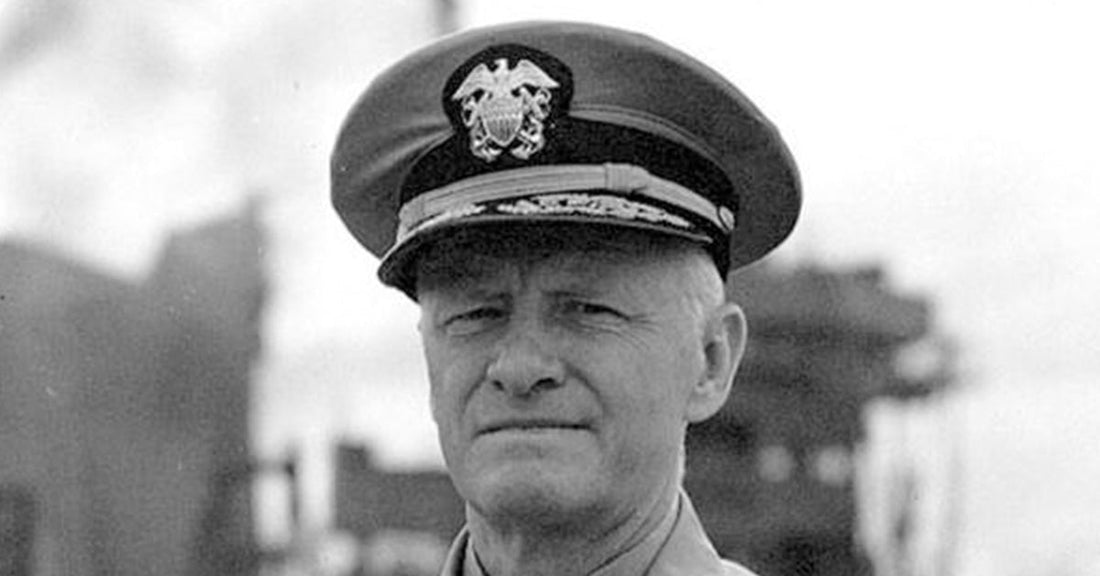
When most people think of legendary military leaders, they don’t imagine someone who got seasick. Yet that’s precisely what makes the story of Fleet Admiral Chester W. Nimitz so remarkable. Rising from humble beginnings and an inauspicious start at sea, Nimitz became a central figure in the Allied victory in the Pacific during World War II. His legacy as a pioneer of modern naval warfare and a steady hand in a time of global crisis continues to resonate today.

Chester William Nimitz was born on February 24, 1885, in Fredericksburg, Texas. Raised in modest circumstances by his widowed mother and grandfather, a former sea captain, Nimitz initially sought a career in the Army. When no appointment to West Point was available, he turned to the U.S. Naval Academy at Annapolis, gaining entry through a competitive exam. Though he had little initial interest in naval life, he quickly rose through the ranks, graduating seventh in his class in 1905.

His early days at sea were far from auspicious. As The New York Times reported, Nimitz admitted to being "frightfully seasick," which dampened his enthusiasm for life on the water. Still, he demonstrated a calm, analytical mind even under pressure. During one incident aboard the U.S.S. Decatur, when the ship appeared to be sinking, Nimitz coolly advised the engineer to consult a manual for the solution. The ship was saved, but his career suffered a temporary setback when he was court-martialed for grounding the vessel in the Philippines. Despite the reprimand, he pressed on, shifting to the submarine service, which offered faster paths to command and innovation.
Throughout the 1910s and 1920s, Nimitz’s career steadily advanced. He commanded several submarines, rescued a drowning sailor (earning the Silver Lifesaving Medal), and married Catherine Vance Freeman, with whom he had four children. He also helped establish the first Naval Reserve Officers’ training unit at the University of California and studied at the Naval War College, where he engaged with War Plan Orange—a strategic framework for a potential conflict with Japan. Decades later, he would reflect that the Pacific war was fought much as it had been envisioned during those early planning sessions.
By the time of the Japanese attack on Pearl Harbor on December 7, 1941, Nimitz was a Rear Admiral and Chief of the Bureau of Navigation. In the wake of the disaster, President Franklin D. Roosevelt appointed him Commander in Chief of the Pacific Fleet. With much of the fleet destroyed and morale at a low point, Nimitz took command aboard the submarine U.S.S. Grayling on December 31, 1941. His task was daunting: to halt Japanese expansion and begin a counteroffensive with limited resources.
One of Nimitz’s key strengths was his ability to build and lead a cohesive team. Despite initial friction with Admiral Ernest King, the two developed mutual respect. Nimitz also surrounded himself with capable subordinates like Admirals Raymond Spruance and William “Bull” Halsey. His approachable demeanor made him popular among both officers and enlisted men. A memorable anecdote from The New York Times describes a sailor who bet he could meet the admiral and casually walked into his headquarters. Rather than reprimanding him, Nimitz took a photo with the sailor to help him win the bet.
His leadership was put to the test during the Battle of the Coral Sea in May 1942 and the Battle of Midway in June that same year. Intelligence breakthroughs allowed Nimitz to anticipate Japanese movements. At Midway, he made the critical decision to engage the enemy despite having fewer operational carriers. The result was a decisive victory that permanently shifted the balance in the Pacific. The Japanese lost four fleet carriers, crippling their naval air power and halting their offensive momentum.
From that turning point, the United States launched a sustained campaign across the Pacific, leveraging its industrial might and military innovation. Nimitz oversaw operations that would eventually bring American forces to the doorstep of Japan. By the end of the war, he commanded more ships, aircraft, and personnel than any officer in history. On September 2, 1945, aboard the U.S.S. Missouri in Tokyo Bay, he signed the Japanese surrender documents on behalf of the United States, marking the official end of World War II.
Following the war, Nimitz served as Chief of Naval Operations, guiding the Navy through postwar demobilization and supporting the development of nuclear-powered vessels. Though he formally retired in 1947, he remained on active duty for life as a five-star Fleet Admiral. He settled in Berkeley, California, and took on roles such as University of California Trustee and Naval Reserve professor. He never wrote memoirs and preferred to avoid the limelight, a reflection of his humble nature.
Chester W. Nimitz passed away on February 20, 1966, at the age of 80. His boyhood home in Fredericksburg now forms part of the National Museum of the Pacific War, preserving the memory of a man whose leadership helped shape the course of history. His portrayal by Woody Harrelson in the 2019 film "Midway" has introduced his story to a new generation, reminding us that even the seasick can steer the course of victory.
