
The Untold Story of William Dawes and the Midnight Ride With Paul Revere
Guest Contributor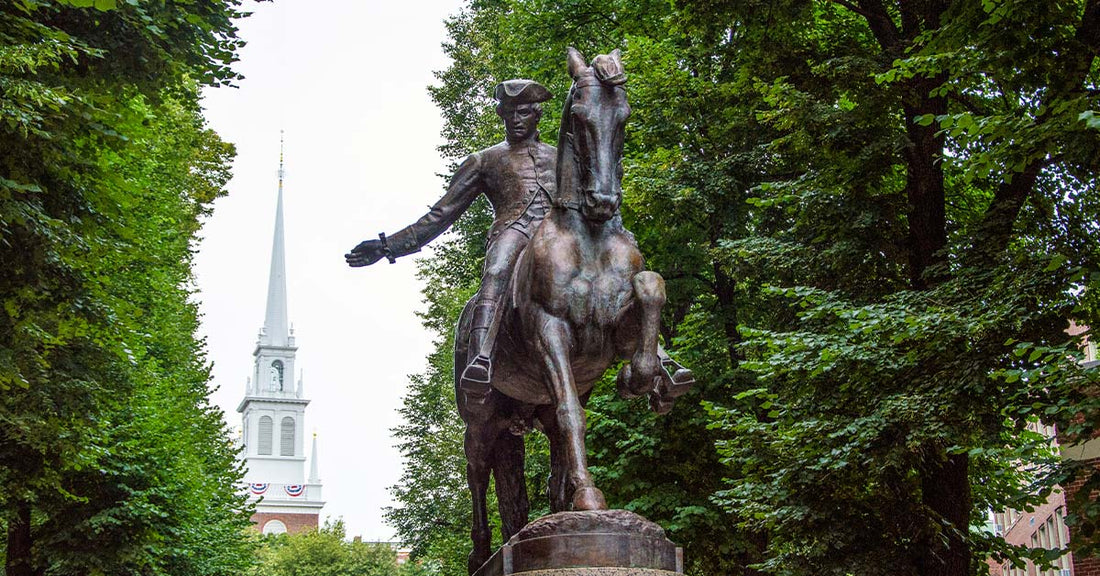
When most people think of the famous midnight ride that warned American colonists of the British advance in 1775, one name comes to mind: Paul Revere. Immortalized in poetry, statues, and school textbooks, Revere’s heroic dash through Massachusetts has become a cornerstone of Revolutionary War lore. But history often favors the storyteller, not the full story. On that very same night, another patriot rode under the same urgent orders, facing even greater risks. His name was William Dawes.

The midnight ride of William Dawes is a compelling example of how historical memory can be shaped more by narrative than by fact. Dawes, a member of the Sons of Liberty, rode alongside Paul Revere on April 18, 1775, to warn John Hancock, Samuel Adams, and the surrounding countryside that British troops were on the move. While Revere took the shorter “by sea” route, Dawes traveled the longer and more dangerous path “by land,” slipping past British sentries under the cover of night. His mission was the same, his courage equal—but his legacy far less known.

Born in Boston in 1745, William Dawes was already the fourth generation of his family to live in the colonies. Though trained as a tanner, he also served in local militia units and joined the Ancient and Honorable Artillery Company of Massachusetts. By 1772, he had become a second sergeant. His military service, however, was only one part of his commitment to the colonial cause. Disillusioned with British rule, Dawes joined the Sons of Liberty, a group known for resisting British authority in increasingly bold ways—including the Boston Tea Party of 1773.
Dawes earned the trust of Dr. Joseph Warren, a leader among the Sons of Liberty, and when Warren received intelligence that British troops were preparing to march on Lexington and Concord, he summoned both Dawes and Revere. Their orders were clear: warn the countryside and alert key revolutionary leaders. Dawes’s route, which took him from Boston to Roxbury and across the Charles River, was longer and more perilous. Yet his familiarity with the area and his reputation as a friendly, unassuming tradesman allowed him to pass British guards undetected. He left Boston around 9 p.m.—an hour before Revere’s departure by boat.
This detail struck me: by the time British troops sealed the city gates, Dawes had already slipped through. His timely exit bought the revolutionaries precious hours. He reached Lexington about half an hour after Revere, and together they warned Hancock and Adams. Joined by local doctor Samuel Prescott, the trio then headed for Concord. But their ride was cut short near 1:30 a.m. when they encountered a British patrol. Revere was captured, Prescott escaped, and Dawes was forced to flee. In a moment of quick thinking, he led the British toward a farmhouse and shouted, pretending to be backed by fellow patriots. The bluff worked, though Dawes was thrown from his horse and had to return to Lexington on foot.
Despite this setback, Dawes had already fulfilled his mission. The next day, the Battle of Lexington and Concord marked the beginning of the American Revolution. Dawes continued to serve, fighting at Bunker Hill and later becoming a major and quartermaster. He lived to see American independence, passing away in 1799.
So why is Paul Revere remembered while William Dawes is largely forgotten? Part of the answer lies in visibility. Revere was a prominent Boston silversmith and left behind firsthand accounts of his ride. Dawes, by contrast, was less well-known, and even those who met him during his mission didn’t always remember his name. One guard recalled him only as “Mr. Lincoln.”
But the most significant factor in Revere’s enduring fame is likely literary. In 1861, nearly a century after the ride, poet Henry Wadsworth Longfellow published “Paul Revere’s Ride,” a dramatic retelling that made it seem as though Revere alone had carried the warning. Longfellow may have been inspired by a Revere biography, but he omitted Dawes entirely. This poetic oversight had lasting effects. One of Dawes’s descendants was so frustrated by the exclusion that he self-published a book in 1878 titled William Dawes and His Ride with Paul Revere, even sending a copy to Longfellow. The poet acknowledged the omission with dry humor, noting that the book “convicts me of high historic crimes and misdemeanors.”
Still, a few have worked to restore Dawes’s place in history. In 1896, poet Helen F. Moore penned a verse in his honor, challenging the one-sided narrative: “’Tis all very well for the children to hear / Of the midnight ride of Paul Revere; / But why should my name be quite forgot, / Who rode as boldly and well, God wot?” Her words serve as a reminder that history is often more nuanced than the stories we inherit.
William Dawes may not have statues or schoolroom fame, but his role in the American Revolution was no less vital. His ride was longer, his path more dangerous, and his fate less celebrated. Yet his courage helped ignite a movement that would change the course of history. As we revisit the origins of American independence, it’s worth remembering that the road to freedom was traveled by many—even if only a few are remembered by name.
